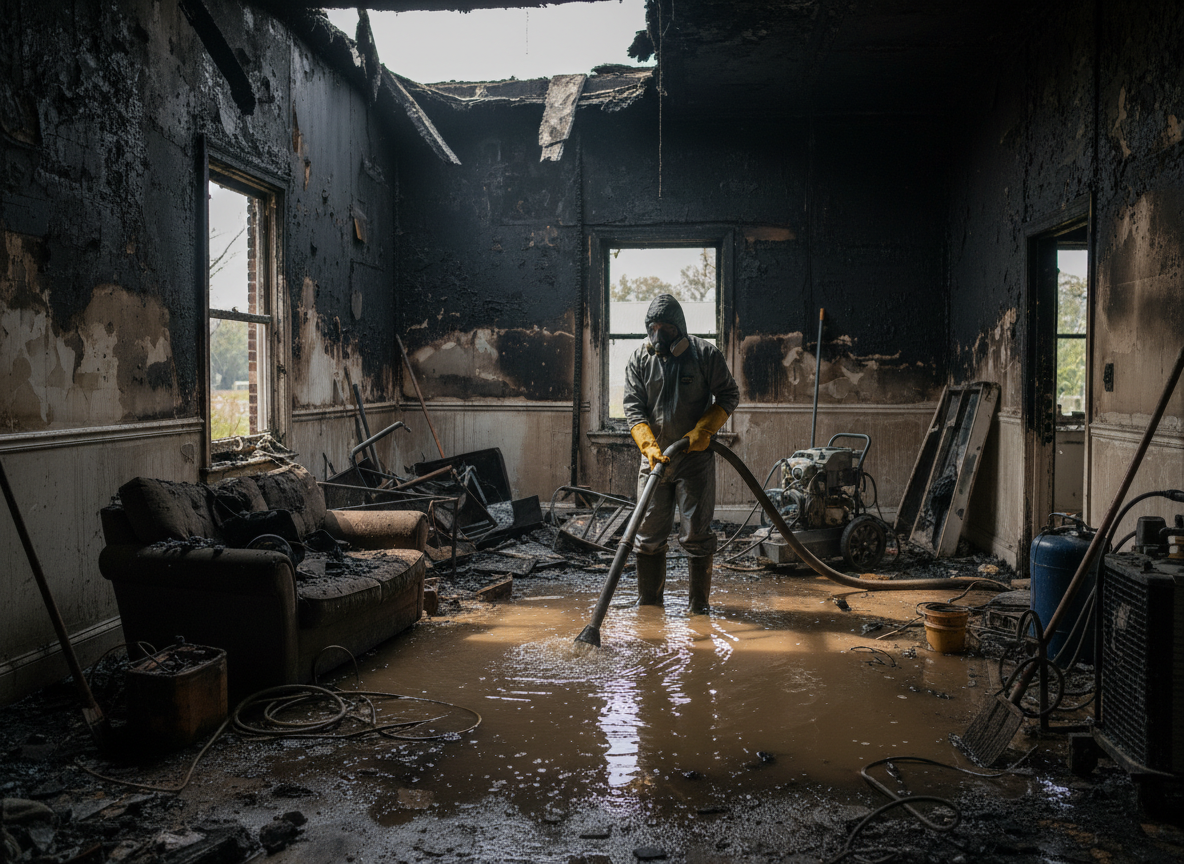
Firefighting water in Atwood homes often saturates older drywall, subfloors, and insulation common in Orange County tract housing built from the 1950s onward. Suppression runoff pools in crawl spaces and behind baseboards where Santa Ana winds push smoke and moisture deeper into wall cavities. Technicians must separate affected materials quickly to prevent mold growth in the region's mild but humid winters.
Hidden damage appears frequently around plumbing chases and electrical runs in Atwood's single-story ranch homes. Soot-laden water migrates along particleboard underlayment, requiring targeted removal rather than surface drying alone. Crews document every layer removed so insurance adjusters see the actual scope before reconstruction begins.
Odor neutralization follows drying because residual smoke compounds bond with gypsum and carpet padding. Negative air machines and hydroxyl generators run until readings drop below detectable levels, a step that fails if moisture remains trapped near the foundation slab typical in this flat terrain.
Technician insight
In Atwood, the thing that catches most people out with water damage remediation after fire is how quickly suppression water travels under the slab-on-grade foundations common in 1960s Placentia tracts. Homeowners assume surface drying is enough, but moisture trapped against the soil stays hidden until it wicks back up into baseboards weeks later.
Placentia-adjacent ranch home after kitchen fire
Suppression water from a stove fire flowed under cabinets and into the living room subfloor. We found saturated particleboard extending eight feet past the visible wet line. Extraction and targeted removal of the underlayment, followed by four days of drying, allowed the owners to keep the original oak flooring in the unaffected rooms.
How it works
- 1
Initial Assessment
Technicians arrive from the 1679 E Orangethorpe Ave base, map water migration paths, and identify materials affected by both fire and suppression water.
- 2
Water Extraction
High-volume pumps and wands remove standing water from floors and cavities before it migrates into adjacent rooms.
- 3
Drying and Monitoring
Air movers, dehumidifiers, and moisture meters run until drywall and subfloor readings return to normal for the Atwood climate.
- 4
Odor and Soot Removal
HEPA filtration and odor-neutralizing equipment treat remaining smoke residues embedded in porous surfaces.
Pricing
Upfront quotes based on affected square footage and materials; final cost depends on hidden damage discovered during drying.